What Proton VPN's Free Plan Actually Gives You
A free tier with no expiration date, and a narrow list of limits. We also name a contradiction on Proton's own pricing page, and explain why this review carries no price at all.
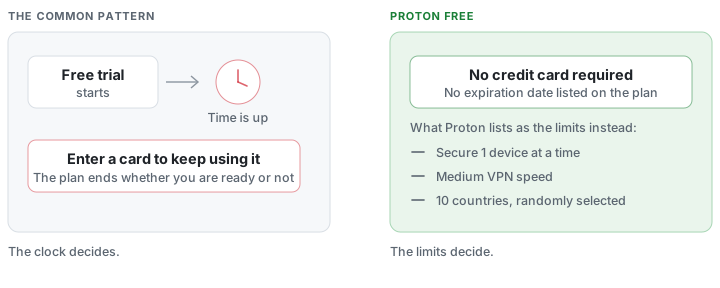
Search for "free VPN" and the results usually split into two patterns. One is a free trial that expires in a week or a month and then asks for a card. The other is rarer: a plan the company itself keeps listed, with no expiration date attached to it.
Proton VPN's free tier falls into the second group. Proton doesn't just remove the app after a trial period. When someone cancels a paid Proton VPN subscription, Proton downgrades the account to Proton Free rather than shutting it off, which only makes sense if Free is a standing tier and not a countdown.
That's worth pausing on, because "no expiration date" and "no restrictions" are two different claims. Proton publishes a specific, narrow list of what the free plan includes. This article works through that list, plus what changes on the paid tiers above it.
We haven't installed or used Proton VPN. Everything below comes from reading Proton's own pricing page and its own page on canceling a subscription, both published by Proton itself.
What We Read, and What We Didn't Test
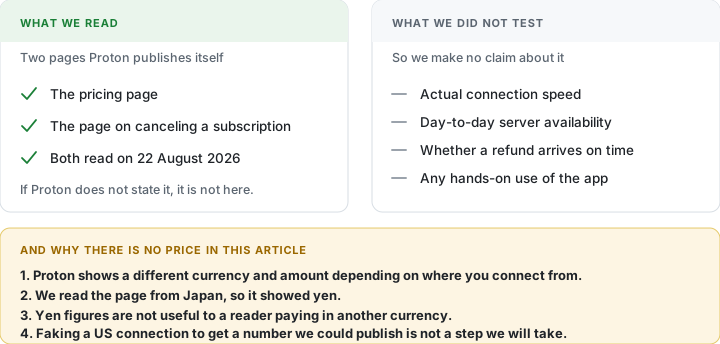
This article is built on two pages: Proton VPN's pricing page, and Proton's support page on canceling a VPN subscription. Both are pages Proton controls and can update at any time.
- What that covers: the plan features Proton states in its own words, the device and speed limits attached to the free tier, and the cancellation and refund terms Proton publishes.
- What that doesn't cover: actual connection speed, real server availability day to day, or whether a refund arrives inside the window Proton states. We're reporting what Proton says, not what we measured.
- If a claim isn't something Proton states on one of these two pages, it isn't in this article.
This article covers Proton VPN only. We haven't researched any other free VPN service, and we're not comparing Proton against another provider by name. If you're weighing Proton against a different VPN, that comparison sits outside what we checked here.
Three Questions Worth Asking About Any Free VPN Plan
Before getting into Proton's specific numbers, a framework helps. A free VPN plan can fail a reader in three different ways, and they're easy to conflate.
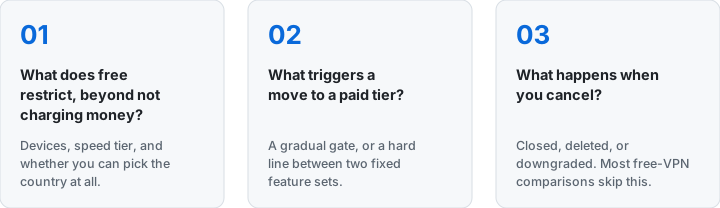
1. What does free actually restrict, beyond not charging money
A plan can be free and still be usable, or free and barely functional. The difference is in the specifics: how many devices, what speed tier, how many server locations, and whether you can pick which one.
2. What triggers a move to a paid tier
Some services gate features behind a paid tier gradually. Others draw a hard line: a fixed feature set below, a distinctly different feature set above. Proton's pricing page draws the second kind of line.
3. What happens to your account when you cancel or stop paying
This is the part most free VPN comparisons skip. Whether canceling deletes your account, keeps it running at a reduced tier, or requires you to re-sign up matters more than the headline features once you've actually used the service.
What Proton Free Includes
Proton's pricing page lists the following for the Free plan, in Proton's own words:
- No credit card required
- Security and privacy for everyone
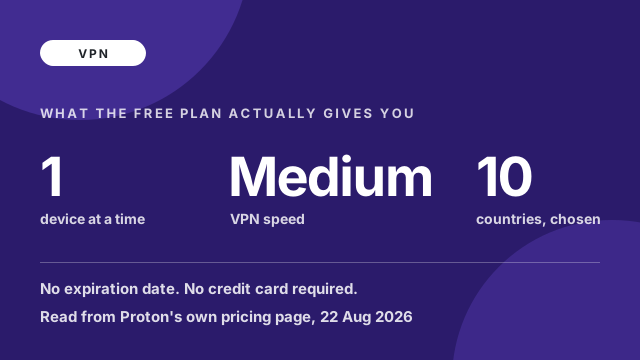
- Secure 1 device at a time
- Medium VPN speed
- Connect to servers in 10 countries (randomly selected)
That last point is specific enough to matter. You don't choose which of the 10 countries you connect through; Proton selects it. For someone who needs a VPN for general privacy on one device, that's a workable set of limits. For someone who needs a specific country's server, a device count above one, or a faster speed tier, the free plan rules itself out before price ever enters the decision.
What "Medium" and "Highest" Speed Actually Mean
Proton describes Free as "Medium VPN speed" and VPN Plus as "Highest VPN speed." Neither label comes with a number attached, no megabits per second, no comparison baseline, nothing we can point to as confirmed.
That's a relative ranking Proton uses to describe its own tiers against each other, not an absolute measurement of either one. We haven't tested either speed ourselves, and Proton's pricing page doesn't give us a number to test against. If real-world speed matters for what you're doing, that's a detail to check through Proton's support or a source that has actually measured it, not something either Proton's label or this article can settle for you.
Proton VPN Plus and Proton Unlimited: What Changes
Proton VPN Plus is the paid VPN-only tier. Proton's pricing page lists these features for it:
- 30-day money-back guarantee
- Advanced features and fastest speeds
- Secure 10 devices at a time
- Highest VPN speed
- Stream your favorite TV shows and movies
- Block ads, trackers, and malware
- Priority support and live chat
Proton Unlimited bundles the VPN with Proton's other products. Proton's own wording uses "up to" for several of these figures, which we're keeping as written instead of treating as a fixed guarantee:
- Access all premium Proton products
- 30-day money-back guarantee
- Enjoy up to 10 VPN connections and all VPN Plus features
- Enjoy up to 500 GB of storage (across Mail and Drive) and all Mail Plus features
- Up to 25 custom, end-to-end encrypted calendars
"Up to" is Proton's ceiling, not a promised number. Treat 500 GB and 25 calendars as maximums tied to a specific plan combination, not as what every Unlimited subscriber gets automatically on day one.
A Discrepancy Worth Naming
Proton's pricing page states two different server counts for VPN Plus, in two different places on the same page. The plan card says: Choose from 20,000+ servers in 140+ countries. The detailed comparison table further down the same page says: Choose from 2000+ servers in 10+ countries.
Both numbers appear on protonvpn.com, on the same pricing page, describing the same plan. We can't tell you which one is current, because Proton's own page doesn't resolve it either. We're not picking the more impressive number and repeating it. We're reporting that the page contradicts itself.
If server count or country coverage matters to your decision, confirm it directly with Proton's support before you subscribe. The two published server counts differ by a factor of ten, and the country counts by a factor of fourteen.
Contract Length and the Missing Price
Proton's pricing page offers Proton VPN Plus on three contract lengths: 1 month, 1 year, and 2 years. The 2-year option is displayed with a 65% off marking against the standard monthly rate.
We're not stating the actual price on any of the three, and we want to explain why plainly instead of skipping past it.
Proton's pricing page shows different currency and amounts depending on where you connect from. We read the page from Japan, and it displayed prices in yen. Yen figures aren't useful to a reader in the US, the UK, or anywhere else reading in their own currency, and converting them would just add a layer of exchange-rate guessing on top of a number that was never meant for that reader.
Seeing the page in US dollars would require connecting from the US. We can't do that honestly from Japan. Using a VPN to make Proton's pricing page believe we're connecting from another country would mean deliberately working around Proton's own region-based pricing to get a number we could publish, and that's not a step we're willing to take to write an article about a VPN.
So we're leaving every amount out, on every tier. Check what your own connection shows on Proton's pricing page directly before you decide.
One more thing we haven't confirmed: whether the 1-year contract carries its own discount marking the way the 2-year contract does. Proton's pricing page showed the 65% off marking attached to the 2-year option when we read it. We didn't record a comparable marking for the 1-year option, and we're not stating a number for it either way. Check the current page for that too.
Canceling or Downgrading
Proton's support page on canceling a VPN subscription states the following, in its own words:
- If you subscribed in the last 30 days, you may be able to request a refund under the 30-day money-back guarantee.
- Proton states it can't issue refunds for bank transfer or cash payments.
- Stated refund timing: payment card, 5-10 business days; PayPal, 1-2 working days; Bitcoin, 1-2 working days; App Store, around 5-10 days; Play Store, around 3-5 days.
- Canceling disables future renewals, so you won't be charged again, but you keep paid features until your next renewal date.
- After that renewal date passes, the account is downgraded to Proton Free, not closed.
- Canceling a subscription doesn't delete the account itself.
That last pair of points connects back to the first section. Proton Free isn't just an entry point; it's also where a canceled paid account lands. That's consistent with a free tier meant to keep running, not a trial with an end date.
We haven't tested how long a refund actually takes in practice. The windows above are what Proton states it aims for, not something we've measured against a real cancellation.
Who the Free Plan Actually Fits
One device, medium speed, and a randomly assigned country out of ten is a real, usable VPN for a narrow set of needs. General browsing privacy on a single phone or laptop, without a specific country requirement, fits inside those limits without much friction.
It stops fitting the moment you need a second device, a specific country, or faster throughput for anything demanding. At that point the comparison isn't free versus paid in the abstract. It's whether VPN Plus's device count, speed tier, and the stated 30-day money-back guarantee justify checking your own currency's price on Proton's page.
There's also a middle case worth naming: someone who isn't sure yet whether they'll keep using a VPN at all. Because Proton downgrades a canceled paid account back to Free instead of closing it, testing VPN Plus and stepping back down if it doesn't earn its place doesn't cost you the account itself. That's a different risk profile than a service that deletes everything on cancellation.
For a household with more than one device, the single-device limit on Free is usually the first wall people hit, well before speed or country selection becomes the deciding factor. If you already know you need to cover a phone and a laptop at the same time, that single fact settles the free-versus-paid question before you look at anything else on the page.
What We Read, What We Didn't Test, and Why There's No Price Above
We read two pages Proton VPN publishes about itself: the pricing page and the cancellation support page. We haven't used the product, haven't measured its speed, and haven't gone through an actual refund.
We also haven't resolved the server-count discrepancy on Proton's own pricing page, because Proton's page doesn't resolve it either. And we haven't written a single price, for the reason above: the number we could see wasn't the number you'd see, and there was no honest way to get the one you'd see from here.
Check Proton VPN's own pricing page for the plan, term, and price shown in your country before deciding.
Sources
| Page | Publisher | Retrieved |
|---|---|---|
| Pricing page | Proton VPN (protonvpn.com) | 22 Aug 2026 |
| Cancel a VPN subscription | Proton VPN (protonvpn.com) | 22 Aug 2026 |
We earn nothing from this article. Nobody paid us to write it, nobody outside this site reviewed it before publication, and we hold no partnership with Proton.