Systeme.io vs the All-in-One Stack: What a Solo Founder Actually Needs to Launch Online
Whether one platform can replace the email tool, the page builder, the course host and the checkout. Plan prices quoted from Systeme.io and GetResponse, with the date we read them.
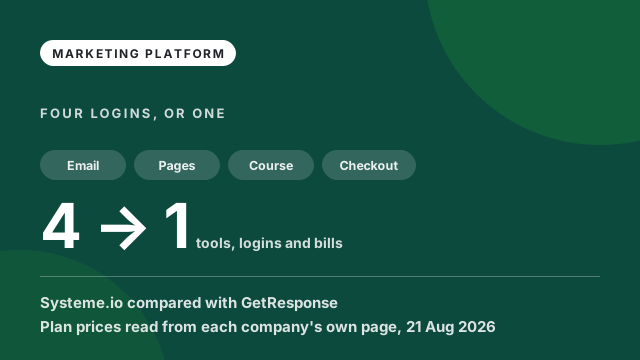
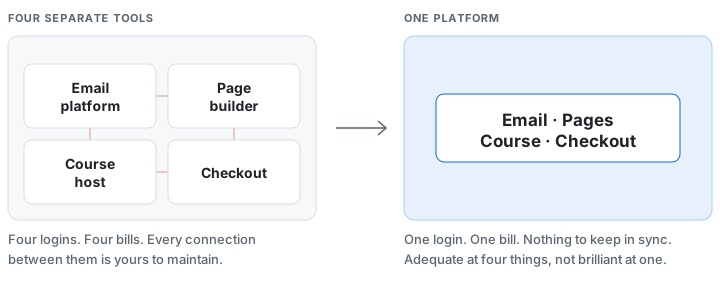
If you're building something on your own, you've probably already lived through the tool-stack problem. An email platform for the newsletter. A separate page builder for the landing pages. A course host for the actual content. A checkout tool bolted on top of all of it.
None of them were designed to talk to each other. Every new tool solves one problem and quietly creates three more: another login, another monthly charge, another integration that breaks the week you're too busy to notice.
That's the itch all-in-one platforms are built to scratch. It's worth being honest about who they're actually for.
- A twenty-person team with a dedicated ops person can usually justify best-of-breed tools stitched together.
- A solo founder or a two-person team generally can't. Not because the stitched-together approach doesn't work, but because nobody has the spare hours to maintain it.
If you're the person writing the emails, building the funnel, and answering support messages, the tool that does four things adequately usually beats four tools that each do one thing brilliantly. You'll actually keep up with it.
What this article is, and what it isn't
This article looks at Systeme.io as the main option, with GetResponse as a direct point of comparison. Both publish clear plan structures aimed at exactly this kind of buyer.
We also name ClickFunnels and Kartra, because you'll run into them in the same searches. We have not evaluated them here, and we're not going to guess at their pricing, features, or fit.
One thing to name upfront:
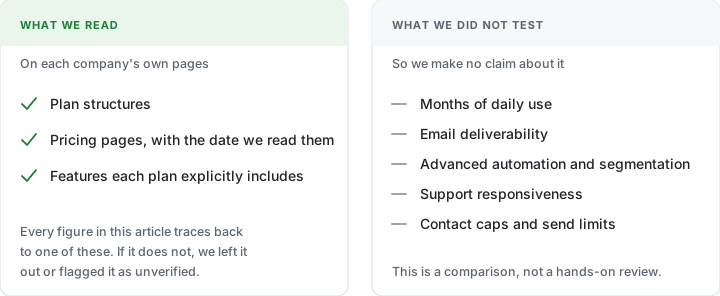
- This is not a review built on months of daily use. It's a comparison built on reading what each company publishes about its own product.
- What that covers: plan structures, pricing pages, and the features each plan explicitly includes, with a consistent framework applied to them.
- What that doesn't cover: anything you'd only learn by using the product. That's a narrower claim than "we tested these platforms," and it's the honest one to make.
- If a claim here can't be traced to something a company states on its own site, we've either left it out or flagged it as unverified.
Three Criteria for Choosing an All-in-One Platform as a Solo Operator
Before comparing products, it helps to have a framework of your own. Otherwise you end up comparing whichever features a vendor chose to put at the top of its homepage.
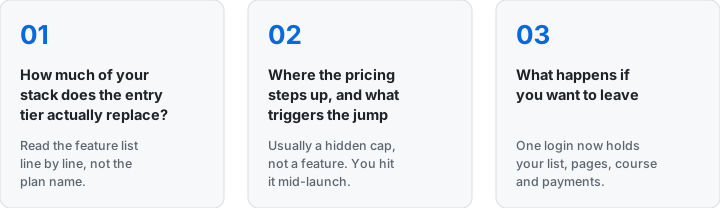
1. How much of your stack does the free or entry tier actually replace?
"All-in-one" is a marketing phrase before it's anything else. The real test is how many separate tools a given plan lets you retire.
Some platforms bundle email, funnels, and course hosting from the entry tier. Others gate the pieces you actually need behind a mid-tier or top-tier plan. That quietly turns an "all-in-one" pitch into "all-in-one, eventually, once you upgrade."
If you're consolidating specifically to cut down on tools and logins, read the feature list on each plan tier line by line rather than trusting the plan name.
2. Where the pricing steps up, and what triggers the jump
Nearly every platform in this category prices on a tier ladder. The trigger for moving up is rarely just "more features."
It's usually a hidden ceiling. A cap on contacts, funnels, courses, or email sends, which you won't notice until you hit it mid-launch.
For a solo founder, the useful question isn't "what does the cheapest plan cost today." It's "what does the plan I'll actually need in a year cost, and what specifically forces the upgrade." That's worth checking on the current pricing page rather than assuming from the marketing copy.
3. What happens if you want to leave
A platform that replaces four tools also concentrates four kinds of risk in one login:
- Your email list
- Your funnel pages
- Your course content
- Your payment setup
That's a reasonable trade for the convenience. But it means export options and portability are worth checking before you commit, not after.
Two questions to answer first: Can you export your contact list? Can you point a custom domain at the pages you build? These matter more here than for a single-purpose tool, because switching later means migrating more at once.
Comparison at a Glance
The prices below are the monthly figures shown on each company's official pricing page at the time we checked. Plan names, feature inclusions, and prices can change. Treat this table as a starting point and confirm the current numbers before you decide.
| Criterion | Systeme.io | GetResponse | ClickFunnels / Kartra |
|---|---|---|---|
| Entry-level plan | Free plan at $0/month | Starter plan at $19/month; no permanently free tier | Not evaluated here |
| Mid-tier plan | Startup at $17/month; Webinar at $47/month | Marketer at $59/month | Not evaluated here |
| Top-tier plan (as listed) | Unlimited at $97/month | Creator at $69/month | Not evaluated here |
| Category focus (based on plan naming) | Funnels, email, and course hosting bundled across tiers | Email marketing and automation, with funnel and marketing-platform features layered in | Not evaluated here |
Sources: Systeme.io pricing page, https://systeme.io/pricing (retrieved 2026-08-21); GetResponse pricing page, https://www.getresponse.com/pricing (retrieved 2026-08-21).
Two things about that table are worth stating rather than leaving implicit:
- "Unlimited" and "Creator" are the vendors' own plan names, not our characterization of what you get. Read the actual feature list behind each name rather than assuming the label describes the contents.
- We deliberately don't list contact caps, email-send limits, or funnel and course counts. Those are exactly the kind of number that changes across plan revisions. They need to be confirmed on the current page rather than repeated secondhand.
Systeme.io: Strengths and Trade-offs
What stands out. The free plan is a genuinely free plan, not a time-limited trial that expires and asks for a card.
For someone testing whether they even want to run a funnel-and-email operation before committing money to it, being able to build and publish before paying anything is a meaningfully lower barrier than a paid-only structure. The plan ladder from there (Startup, Webinar, Unlimited) is also priced lower at each step than GetResponse's comparable tiers, based on the numbers both companies currently publish.
Where it falls short for some users. A platform that bundles funnels, email, and course hosting into one product is, by definition, not a specialist at any one of them.
If deliverability, advanced email automation, or granular segmentation is the single most important factor in your decision, weigh that against the convenience of one login. That's a comparison this article isn't making, since it would require independently testing email deliverability, which we haven't done.
We're not listing specific feature counts, template numbers, or automation-step limits for Systeme.io beyond what's in the pricing table above, because we haven't independently verified those figures against the current official specification pages.
Who this trade-off suits. Someone consolidating from a handful of separate tools who wants to test the consolidated version at no cost before paying for more capacity.
If you're launching your first paid course and don't yet know whether you'll need webinar functionality or unlimited contacts, starting on the free plan and upgrading only once you hit an actual limit avoids paying for capacity you haven't used yet.
GetResponse: Strengths and Trade-offs
What stands out. GetResponse's plan structure is built around email marketing and automation first, with the broader marketing-platform features layered on top of that core.
For a founder whose business runs primarily on a newsletter or an email-driven launch sequence, an email tool that treats email as the primary product, rather than one feature among several, can matter more than a lower headline price on a bundled competitor.
Where it falls short for some users. There's no permanently free tier. The Starter plan begins at $19/month, which is a real cost from day one rather than a $0 starting point.
For someone who hasn't yet validated that they'll use the platform consistently, that upfront cost is a genuine trade-off against Systeme.io's free tier, even though $19/month is a modest figure in absolute terms.
As with Systeme.io, we're not stating specific automation-step counts, template numbers, or send-volume figures for GetResponse beyond the plan prices above, since we haven't independently confirmed those details against the current official pages.
Who this trade-off suits. Someone whose primary channel is email, and who wants funnel and page-building features as an addition rather than the core product.
If your business already runs on a list you're actively growing, and funnels are a secondary need, GetResponse's email-first structure may match your actual workflow better than a funnel-first bundle would.
ClickFunnels and Kartra: Not Evaluated Here
Both names come up constantly in searches for all-in-one marketing platforms, and you'll run into them alongside Systeme.io and GetResponse.
We have not read either company's official pricing or terms pages. So we're not stating their plan prices, features, or fit for any type of user.
If you're considering either, treat that as a gap in this article to fill with your own research on their official sites. It is not a comparison this article has already made on your behalf.
Which One Fits Your Situation?
If you're launching your first paid course and haven't validated demand yet. Systeme.io's free plan lets you build the funnel, the email sequence, and the course delivery without paying anything until you have paying customers to justify an upgrade. The risk of over-investing in infrastructure before your first sale is close to zero on a $0 plan.
If your business already runs on an active email list and funnels are secondary. GetResponse's email-first plan structure is likely a closer match to how you work day to day, since the product is built around the channel you rely on most.
If you're consolidating three or four tools and cost matters more than any single feature. Systeme.io's lower price at each comparable tier is worth weighing seriously, provided the bundled versions of email, funnels, and course hosting cover what you actually need. Confirm that against your specific feature list before switching, not after.
If you're not sure which category you fall into. That uncertainty is itself useful information. Start on whichever platform has a genuinely free or low-cost entry point, test your actual workflow against it for a real launch cycle, and pay for a higher tier only once you've hit a limit you can point to.
There's no single answer that fits every solo founder. The right one depends more on which channel is actually central to how you sell, email or funnels, than on which platform has the longer feature list.
Questions Worth Asking Before You Commit
These apply to the category as a whole rather than to either company specifically.
What exactly triggers an upgrade? Some platforms gate you by number of contacts, others by funnels, courses, or active automations, and others by monthly email sends. The trigger matters more than the plan price, because it determines how predictable your costs are as the business grows. Read the feature comparison table, not just the plan names.
Can you take your list and pages with you if you switch later? Consolidating four tools into one is convenient, but your email list, funnel pages, and course content then live behind a single login. Before you build out a full funnel, check two things:
- Can contacts be exported in a standard format?
- Can a custom domain you already own be pointed at pages you build there?
Those two details determine how painful switching later would be. Confirm them on the current terms and help pages rather than assuming.
Does the free or entry tier let you publish a real, working funnel, or just a demo? Some free and entry tiers cap you at a single funnel or a small number of pages. That's fine for testing the workflow, but not enough to run a launch. If you plan to use the entry tier for more than a trial, check the specific page, funnel, and contact limits attached to it.
Is support included at the tier you're actually paying for? Solo founders don't have an internal team to troubleshoot a broken automation or a payment integration that stops working mid-launch. Support responsiveness and the channels available (chat, email, or a community forum) can vary meaningfully between entry-level and top-tier plans.
None of these questions has a single right answer for every solo founder. That's exactly why they belong on the official pricing, terms, and help pages rather than in a comparison article that can't promise the details haven't changed since it was written.
Getting Started
Both platforms let you start without committing to a long research project first.
- Systeme.io's free plan is a reasonable way to test a bundled funnel-and-email workflow at no cost before paying for anything.
- GetResponse's Starter plan is a low-cost way to begin if email is already the center of how you reach customers.
Either way, a more useful next step than reading another comparison article is opening the platform, building one real page or one real sequence, and seeing whether the workflow fits how you work, before deciding whether to pay for more than the entry tier.
Sources referenced in this article: Systeme.io pricing page, https://systeme.io/pricing (retrieved 2026-08-21); GetResponse pricing page, https://www.getresponse.com/pricing (retrieved 2026-08-21).
Sources
| Page | Publisher | Retrieved |
|---|---|---|
| Pricing page | Systeme.io (systeme.io) | 21 Aug 2026 |
| Pricing page | GetResponse (getresponse.com) | 21 Aug 2026 |
We joined Systeme.io's affiliate programme on 21 August 2026 and the button above is an affiliate link. We were not paid to write this, nobody outside this site reviewed it before publication, and no other company named here pays us anything.